Guides
Who should operate on-field graphics during a football game?
Sports broadcast graphics package setup needs a trained operator. Assign roles, test the video path, and rehearse removing incorrect lines before kickoff.
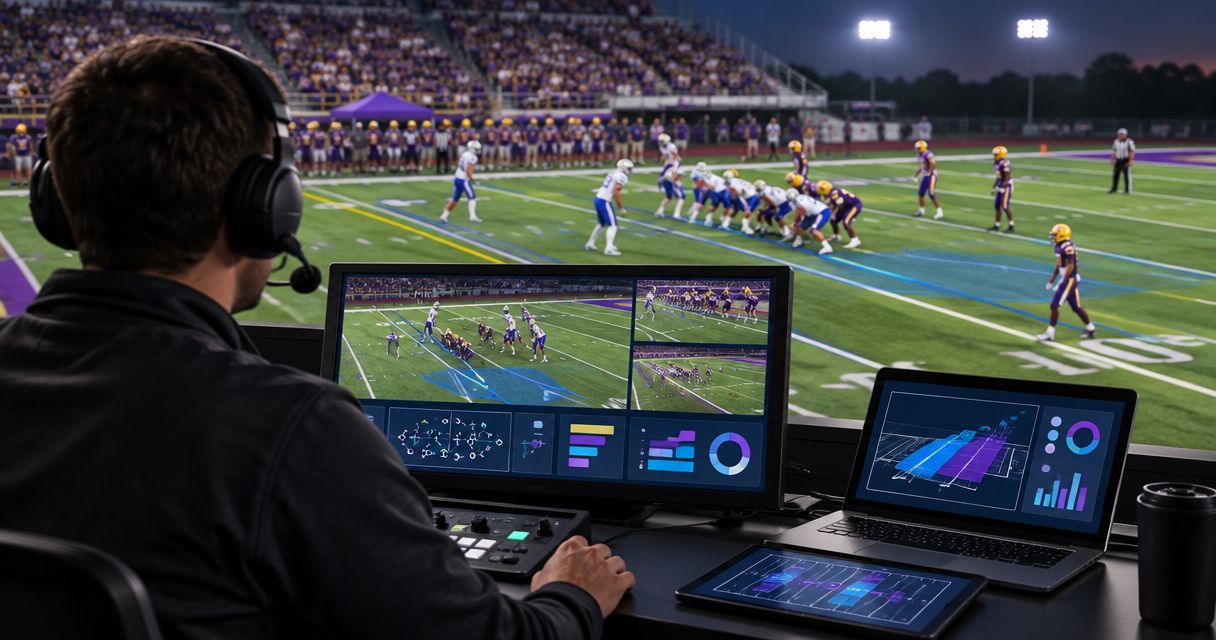
Assign on-field football graphics to a trained operator who can follow the game, update line positions, and remove graphics when they are wrong; use a dedicated operator when staffing allows. If someone must combine jobs, protect that person from conflicting live duties and give the director clear authority to keep graphics off air.
TL;DR
- Sports broadcast graphics package setup needs a named operator, a director’s approval, and a rehearsed graphics-off procedure.
- Choose a dedicated graphics operator when staffing allows; combine duties only after a realistic rehearsal.
- PayneXR is for football production teams that need Windows-based on-field graphics.
- Broadcast without on-field lines whenever the crew cannot confirm their placement.
Why this matters
A first-down line gives viewers a visible target. An incorrectly positioned line gives them the wrong target. Adding graphics therefore adds an editorial responsibility, not just another computer to the production table.
PayneXR provides Windows software for virtual first-down lines, scrimmage lines, logos, and sponsor graphics. Those elements need different decisions: line placement follows the game, while sponsor placement follows production cues. Assign both responsibilities before kickoff rather than assuming the person nearest the graphics computer owns them.
For your 2026 production plan, treat graphics staffing as part of the show’s operating procedure. The important question is not who can open the application. It is who can keep the displayed information correct while the rest of the broadcast continues.
Who should operate on-field graphics during a football game?
Choose the person who can watch the field, understand the next play, and respond to the director without abandoning another live responsibility. Software familiarity matters, but it does not replace attention or football knowledge.
Use this assignment process:
- Name the primary operator. Make one person responsible for line placement and graphic visibility. Avoid shared ownership in which everyone assumes someone else checked the display.
- Name the backup operator. Identify who takes over during a break, equipment problem, or absence. The backup needs a rehearsal, not just a password.
- Define the information source. Agree how the operator confirms the line of scrimmage and line to gain. The broadcast overlay must follow the game’s established position, not an operator’s guess.
- Separate preparation from approval. The operator prepares the graphic; the director decides whether it belongs in the live output. On a small crew, say explicitly when one person performs both jobs.
- Rehearse removal. Practice taking the graphic off while keeping the football video on air. Every assigned operator needs to know the actual removal method in the production setup.
A useful staffing recommendation is 1 primary operator and 1 trained backup. That is an operating plan, not a software requirement or a claim that both people must sit at the graphics station throughout the game.
Adding on-field graphics versus broadcasting without them
The central choice is whether your crew can support the added responsibility. A broadcast without virtual lines remains an option; adding lines should not compromise the underlying video production.
| Approach | Best for | Benefit | Trade-off |
|---|---|---|---|
| Dedicated on-field graphics operator | Crews that can assign a separate graphics role | Gives line placement and removal their own owner | Requires a separate staffing assignment |
| Combined-role graphics operator | Crews whose rehearsal demonstrates manageable duties | Adds on-field context without assigning a separate operator | Conflicting live tasks can leave graphics unattended |
| No on-field graphics | Crews without a reliable operator or confirmed placement | Removes the on-field graphics workload | Viewers do not receive virtual field-position cues |
Use on-field graphics only when someone owns their accuracy. If your rehearsal exposes unresolved conflicts, broadcast without the lines until the crew can handle them reliably.
Dedicated graphics operator: best for divided live responsibilities
A dedicated operator is the clearest assignment when the camera operator must follow action, the director must select shots, and the commentator must describe the play. The graphics operator watches for changes that affect the overlay rather than borrowing attention from those jobs.
Give this person a usable view of the game, access to the relevant production communication, and a way to inspect the output viewers receive. Define “program” during training: it means the final live picture leaving the production, not simply an application window.
The benefit is clear ownership. The limitation is staffing: assigning someone to graphics means that person is not available for another production position. Do not quietly add replay selection or unrelated troubleshooting and continue treating the assignment as dedicated.
For a TV broadcaster, write down the division between the on-field graphics operator and whoever runs other graphics. For a school team or independent crew, the same principle applies even when job titles are informal.
Combined-role operator: best for a rehearsed small crew
A combined role is an option when the same person can complete both duties without missing a live decision. Test the actual pairing rather than assuming any computer-based tasks fit together.
For example, scheduling a sponsor graphic during a planned break differs from updating a line while also choosing the live camera. The first can be prepared around the action; the second creates simultaneous demands. Rehearse the busiest moments, not just a quiet possession.
Approve a combined role only after the operator demonstrates the complete workload. The advantage is a smaller staffing assignment. The disadvantage is reduced attention whenever both jobs need action together.
Keep a written priority rule at the station: protect the live video, remove uncertain on-field graphics, then restore graphics after verification. Never make an operator choose between guessing a line position and missing a required production cue.
Broadcasting without on-field graphics: best for unresolved staffing
Choose a clean football picture when nobody can reliably maintain the overlays. Here, “clean” means video without the on-field graphics being discussed, not necessarily video without a scoreboard or other broadcast elements.
This approach removes line placement and removal from the live workload. Its limitation is straightforward: viewers lose the virtual first-down and scrimmage references that the overlay would provide.
You can still plan an on-field graphics workflow for a later production. Use rehearsal to resolve the staffing problem before making the live game the test environment.
Why the operator assignment varies
The correct assignment follows the work your crew must perform, not the size of the organization’s name. Review these factors in your 2026 staffing sheet:
- Overlapping duties. Camera operation, shot selection, commentary, and graphics updates compete when they require attention at the same moment.
- Football understanding. The operator needs to recognize changes in possession, field position, and the next line to gain before displaying a graphic.
- Production communication. Decide how the operator receives cues and how the director learns that a graphic is ready or uncertain.
- Output visibility. The operator needs to inspect what reaches the broadcast, not just what appears inside the graphics application.
- Handover readiness. A backup must understand the current game state and the removal procedure before taking control.
- Graphic responsibilities. Lines, logos, and sponsor graphics need explicit ownership even when one person handles all of them.
Do not use the presence of a technically confident volunteer as the entire staffing plan. Confirm that the volunteer can perform the game-related decisions as well as the computer operations.
Build the graphics workflow before assigning extra duties
Your sports broadcast graphics package setup needs a documented signal path: the route video and graphics take through the production. Confirm the connections supported by your actual equipment and software before assigning the operator responsibility for that route.
Use these checkpoints during your 2026 rehearsal:
- Video source. Identify the football video that the graphics workflow uses. Confirm who supplies it and who handles a source failure.
- Graphics stage. Identify where the on-field elements are added. Record who controls placement and visibility.
- Program check. Inspect the final live picture for the intended graphic and the correct field position. Check the output, not just the controls.
- Clean fallback. Demonstrate how the crew keeps football video on air without the on-field overlay. Do not assume closing an application creates a usable fallback.
These checkpoints describe responsibilities, not a promise that every setup uses the same cable, capture device, or output method. Confirm those details against the equipment and software you actually use.
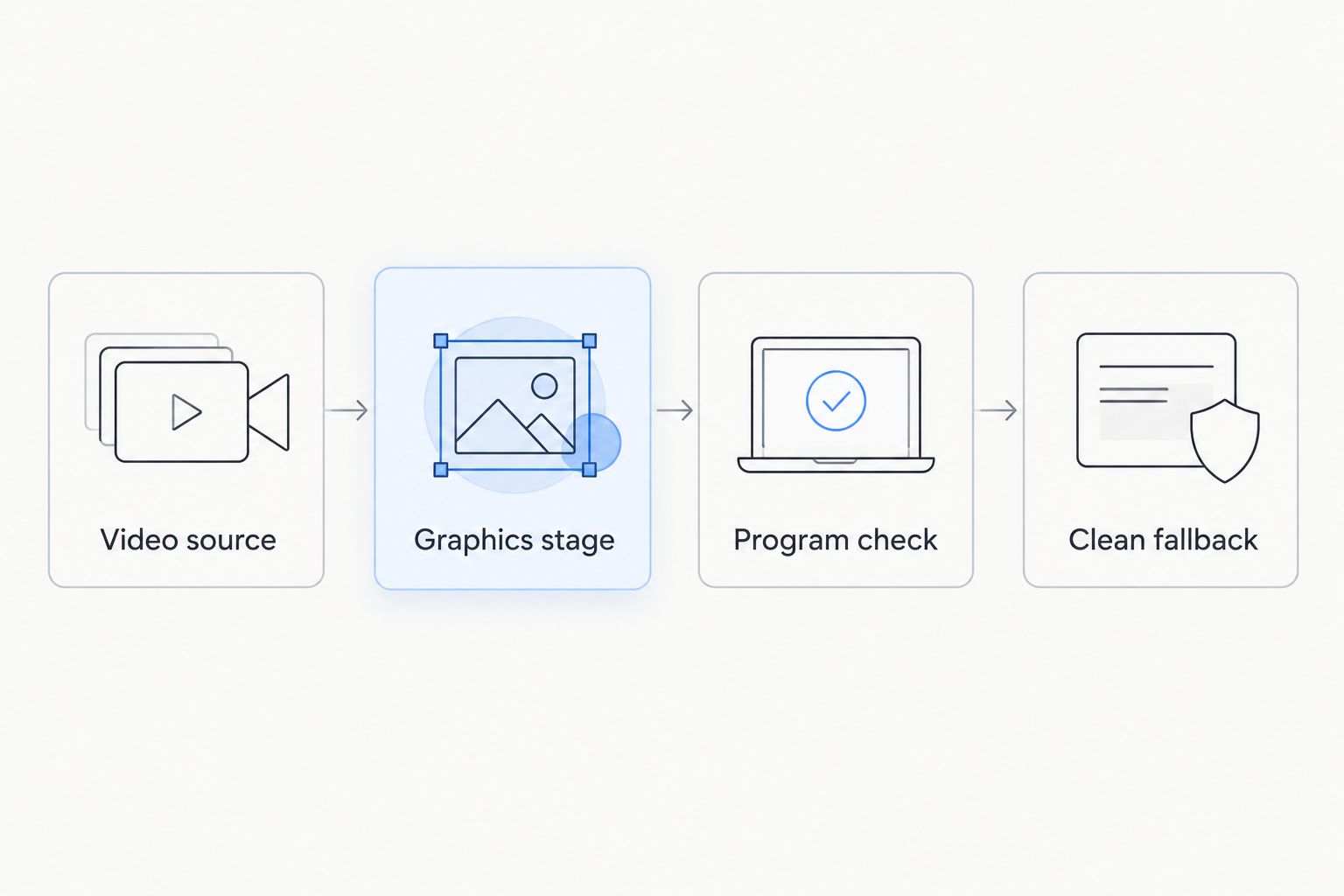
Verify the final picture and the clean fallback before kickoff.
For computer planning, use the guide to computer requirements for football broadcast graphics. Keep equipment checks separate from staffing approval: a working computer does not establish that its operator can cover another live role.
Match the assignment to your production team
School football broadcast teams
Give student or volunteer operators a written role description and supervised practice before the live assignment. Teach the football decisions alongside the software controls; knowing how to show a line does not establish where that line belongs.
Use the same handover notes each game. Include the primary operator, backup, cue source, and removal procedure. The benefit is a repeatable assignment; the limitation is that a written checklist cannot replace rehearsal.
Independent sports streaming crews
List every job each crew member performs during live play. Mark the moments when graphics updates overlap with switching, camera work, commentary, or troubleshooting.
If the same person owns several simultaneous actions, simplify the show or leave on-field graphics off. A small crew needs a workflow it can execute, not an assignment sheet that hides the conflict.
TV broadcasters
Define the boundary between on-field graphics, other graphics, and direction. Give each function an identified owner even when the production groups them within the same department.
Agree who can request removal and who confirms readiness to return. Established job titles do not remove the need to test those decisions in the actual production path.
Where PayneXR fits in the assignment
PayneXR is for football production teams that need Windows-based on-field graphics. Its stated functions include virtual first-down lines, scrimmage lines, logos, and sponsor graphics over live football video.
That makes PayneXR relevant when your production calls for those elements. It does not remove the staffing trade-off: someone still needs to confirm placement, respond to cues, and inspect the broadcast picture. Treat that human responsibility as part of the setup, not as an optional task after installation.
Can the camera operator also run on-field graphics?
Do not make the active game-camera operator your default graphics operator. Following the play and updating field graphics can require attention together, so approve that pairing only after a realistic rehearsal demonstrates a workable division of duties.
If the camera operator cannot leave the shot unattended, give graphics to someone else or keep them off. Protect the camera’s primary job.
Does the graphics operator need football knowledge?
Yes. The graphics operator needs enough football knowledge to follow possession, the line of scrimmage, and the line to gain, while recognizing when a placement needs confirmation.
Teach uncertainty handling as part of the role. Removing an unconfirmed line is a better operating decision than leaving a plausible-looking line on air.
Who should decide when an incorrect line comes off?
Give the director authority to keep an incorrect line off air, and authorize the operator to flag uncertainty immediately. Write the removal cue into the production plan so that a correction does not become a debate during the play.
For your 2026 rehearsal, test both a normal removal cue and an operator-initiated warning. Confirm that the crew knows who acts in each case.
FAQ
What's the best person to operate on-field football graphics?
The best person is a trained operator who can follow the game, maintain accurate line placement, and respond to production cues. Assign a dedicated operator when staffing allows.
Can a small streaming crew add virtual first-down lines?
A small streaming crew can plan for virtual first-down lines if someone can own placement and removal without neglecting another live duty. Test the combined workload before using it during a game.
Should the commentator control the on-field graphics?
Do not make the commentator the default on-field graphics operator. Describing a live play and updating graphics can compete for attention; rehearse that pairing before approving it.
What should sports broadcast graphics package setup include?
Sports broadcast graphics package setup should include a verified video path, a named operator, clear production cues, an output check, and a graphics-off procedure. Include the backup operator in rehearsal.
Does PayneXR replace the need for a graphics operator?
Plan for an operator when using PayneXR football broadcast graphics. The crew still needs someone responsible for placement, visibility, and checking the final picture.
What should the crew do if a first-down line looks wrong?
Remove the uncertain first-down line and verify its placement before restoring it. Keep the football video on air through the tested fallback workflow.
Do we need a backup graphics operator at every game?
Name a trained backup as part of the operating plan. The backup does not need a separate full-game graphics assignment, but must understand the handover and removal procedure.
One last thing
Before your first live use in 2026, rehearse a deliberately incorrect line. Ask the operator to flag it, the director to call for removal, and the crew to preserve the football picture.
That exercise tests the decision that matters when something goes wrong. If the crew cannot remove a bad graphic confidently, keep on-field graphics off until it can.