Guides
When is broadcasting football without on-field graphics enough?
Broadcast graphics software for football is optional when clear coverage explains the game. Compare crew needs, virtual lines, and rehearsal checks.
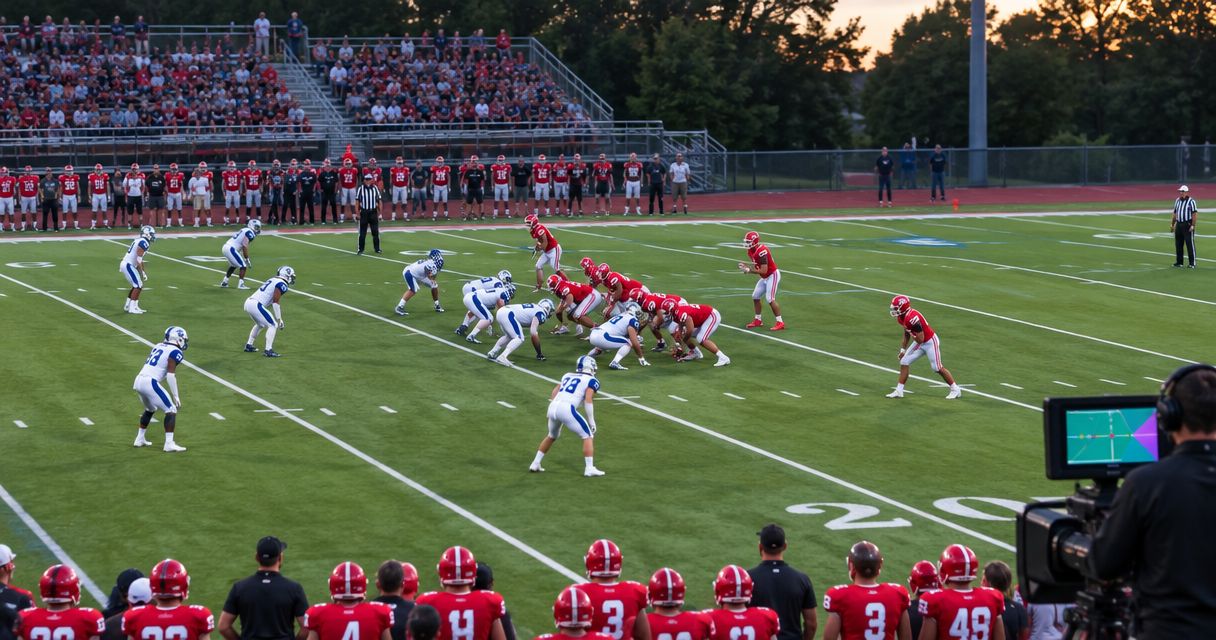
Broadcasting football without on-field graphics is enough when viewers can follow the ball, understand the game situation, and hear accurate commentary without virtual lines. Add broadcast graphics software for football when showing the line to gain or delivering on-field sponsor graphics serves a defined production need—and your crew can operate those graphics without weakening the core broadcast.
TL;DR
- Broadcasting without on-field graphics is enough when clear pictures and accurate commentary explain the game.
- Broadcast graphics software for football adds visual context but also adds routing, operation, and checking tasks.
- PayneXR suits football production teams seeking Windows software for virtual first-down lines and on-field graphics.
- Prioritize dependable video and audio before adding virtual lines or sponsor graphics.
When is broadcasting football without on-field graphics enough?
A broadcast without virtual lines is enough when the audience can understand the play and your production meets its editorial and sponsor commitments. On-field graphics are an addition to that foundation, not a substitute for it.
Here, on-field graphics means virtual elements placed over the playing surface, such as first-down lines, scrimmage lines, logos, and sponsor graphics. A score display or a player-name caption serves a different purpose; you can use those without placing graphics on the field.
PayneXR supplies Windows software for the on-field approach. Decide whether your broadcast needs that approach before planning another production task.
| Production consideration | Without on-field graphics | With on-field graphics |
|---|---|---|
| Best for | Crews prioritizing a dependable core broadcast | Crews with a defined need for virtual lines or field graphics |
| Explaining field position | Relies on the camera view, field markings, and commentary | Adds a visible reference for the scrimmage line or line to gain |
| Crew workload | Avoids a separate field-graphics task | Requires responsibility for graphics operation and checking |
| Sponsor presentation | Uses other agreed placements | Adds an on-field placement when included in the production plan |
| Main advantage | Fewer graphics-related tasks to coordinate | More visual context directly over the playing surface |
| Main limitation | No virtual reference for viewers judging the line to gain | Incorrect or distracting graphics can confuse the picture |
Why this matters
For your 2026 production plan, judge graphics by the viewer problem they solve. A virtual first-down line helps explain where the offense needs to reach. It does not fix an unclear camera shot, missing commentary, or an interrupted feed.
The line to gain is the field position the offense must reach for a new first down. It is usually 10 yards from the start of a series, although penalties and proximity to the goal line change the situation. Showing that location serves a different purpose from simply adding another graphic to the screen.
You do not need to make every broadcast look identical. A school crew, an independent streaming business, and a television production can reasonably reach different decisions because they have different assignments, staffing, and delivery requirements.
Broadcasting without on-field graphics: best for protecting the basics
Choose the simpler approach when operating virtual lines would compete with keeping the game visible and audible. That includes a production where the same person already handles camera switching, audio checks, and stream supervision.
The benefit is operational focus. You remove the need to prepare, display, monitor, and clear an additional graphics layer. The trade-off is that viewers must judge field position from the actual picture and the announcer's explanation.
Before accepting that trade-off, watch your normal wide shot as a viewer would. Can you identify the ball's location? Can you follow the play without the camera losing the action? Does commentary explain down and distance before the snap?
Keep the broadcast free of on-field graphics when the core presentation works and no production requirement calls for them. Simplicity is a valid production decision, not an unfinished upgrade.
Adding on-field graphics: best for a defined visual need
Add virtual lines when you want the audience to see the relationship between the ball's starting position and the first-down target. Add logos or sponsor graphics when those placements belong in the agreed broadcast plan.
The benefit is direct visual explanation over the field. The limitation is another live element that needs correct placement, appropriate timing, and a clear removal procedure. An inaccurate line is not better than no line.
PayneXR is best for football production teams seeking Windows software for virtual first-down lines and on-field graphics. Its stated scope includes scrimmage lines, logos, and sponsor graphics; confirm your intended signal path and computer requirements before making it part of the show.
Treat the software as a production component, not a replacement for editorial judgment. Someone still needs to decide when a field graphic explains the action and when the picture should remain clear.
Why the right graphics setup varies
Your 2026 decision should follow the work your crew actually performs, rather than the number of graphics another broadcaster uses.
- Audience context: Decide whether viewers need a visible line-to-gain reference beyond the field markings and commentary.
- Crew responsibility: Assign graphics to someone who can check them without abandoning another essential task.
- Signal routing: Establish where the graphics enter the production and how you remove them from the final picture.
- Sponsor commitments: Match placements to what the production has agreed to deliver, rather than adding logos without a purpose.
- Camera coverage: Rehearse the camera views and movements you intend to use with field graphics.
- Recovery procedure: Keep a clear route back to a picture without the on-field layer.
These factors apply across production sizes. A larger crew still needs clear ownership, while a smaller crew can add graphics when the workflow fits its responsibilities.
What each football production team should prioritize
School football teams: best for a repeatable crew routine
For a school football broadcast, start with a setup the assigned crew can repeat. Document who prepares the feed, who checks audio, who communicates game information, and who watches the outgoing picture.
If graphics operation has no clear owner, leave virtual lines out of the live plan until rehearsal resolves that gap. Adding an unassigned task does not improve the production.
When the crew is ready, introduce the field-graphics task with written setup and removal instructions. The advantage is a repeatable visual presentation; the drawback is another responsibility that must remain covered when crew assignments change.
Independent streaming crews: best for a repeatable client service
For an independent crew, define the deliverable before choosing the setup. Establish whether the job calls for straightforward game coverage, virtual first-down lines, sponsor placements, or a combination.
A simpler broadcast reduces the graphics work you must prepare and supervise. A graphics-equipped broadcast adds a distinct visual deliverable, but it also needs a documented setup that your crew can reproduce at the assigned venue.
For 2026 jobs, put that distinction in the production brief. Do not let an example image become an implied promise that nobody has planned to operate.
TV broadcasters: best for a documented production requirement
For a television broadcast, tie field graphics to the show's editorial plan and technical requirements. Identify which camera views will carry them, who authorizes their use, and who removes them when the shot changes or the information is uncertain.
The advantage is a shared plan across production roles. The cost in operational terms is coordination: the graphics task must fit the existing direction, switching, and output-checking process.
A clean feed—a version of the picture without selected graphics—also needs a clear definition when the production requires one. Specify which elements are absent rather than assuming that everyone uses the term the same way.
How do you decide before adding football graphics?
Use a rehearsal to answer the decision, not a feature list. For your 2026 rehearsal, follow the intended video path from the source picture to the outgoing program, meaning the final picture sent to viewers.
- Define the need. Write the viewer or sponsor requirement the on-field graphic will serve. If you cannot name one, keep the simpler presentation.
- Assign an operator. Name the person responsible for displaying, checking, and clearing the graphics. Check that the assignment does not conflict with another essential role.
- Map the signal. Identify the video source, graphics stage, production system, and destination. Verify the connections and formats for the equipment you actually use.
- Rehearse the picture. Run the intended camera views and movements. Check the outgoing image, not just the graphics application's preview.
- Test removal. Practice taking the on-field layer off while retaining the game picture. Make the removal instruction clear to everyone involved.
The connection details depend on your chosen equipment and software. Do not assume a connector, video format, or transfer method works merely because both devices handle video; confirm the supported input and output requirements before connecting the chain.
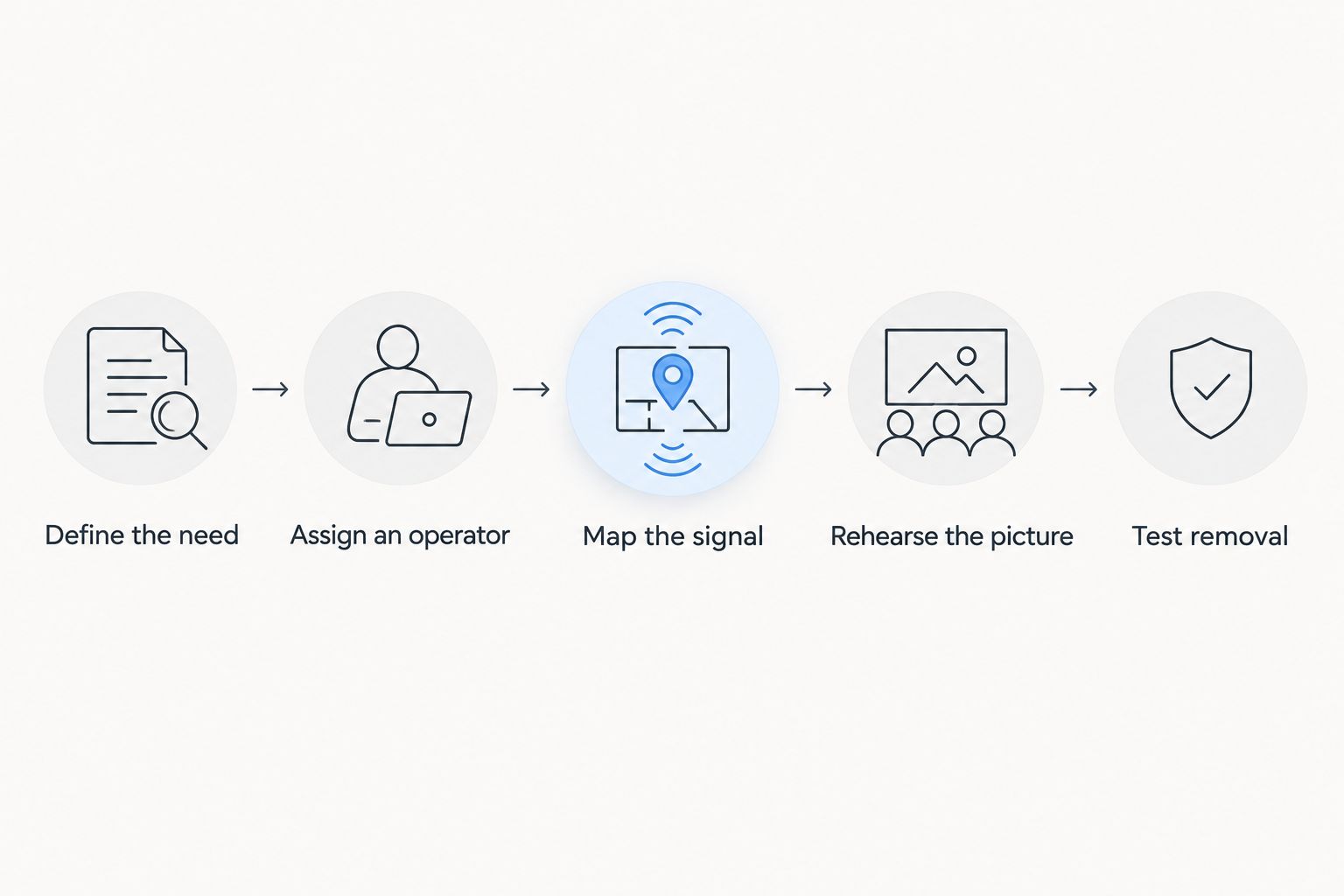
Rehearse both the graphics presentation and the return to a picture without it.
A useful rehearsal ends with a decision. Either the setup serves its purpose and the crew can operate it, or the production stays with a picture without virtual lines until the unresolved step is fixed.
What should you check in the outgoing picture?
Review the broadcast as the audience receives it. A graphics preview confirms only part of the chain; the outgoing picture shows whether the intended result reaches the viewer.
Check these points during rehearsal:
- Game information: Confirm that the displayed line corresponds to the current situation, not the previous play.
- Field placement: Watch whether the graphic sits where you intend across the camera views used in the show.
- Picture clarity: Check whether the graphic obscures action or competes with other information.
- Transitions: Watch what happens when you change shots, enter replay, or leave the field view.
- Removal: Confirm that the designated person can clear the layer on instruction.
Do not judge the setup from a single attractive still image. Live production includes changes in possession, camera framing, and editorial attention. Your rehearsal should include those changes rather than only the easiest wide shot.
If the graphics become uncertain, clear them and keep showing the game. Restore them only after the responsible operator has checked the situation.
Can viewers follow football without a virtual first-down line?
Yes. Viewers can follow football without a virtual first-down line when the camera picture, field markings, game information, and commentary explain the situation. The line adds a visual reference; it is not the only way to communicate down and distance.
A standard series gives the offense 4 downs to gain a first down. Clear commentary should explain the current down and required distance rather than assuming an on-field overlay carries that information alone.
Should you add sponsor graphics before virtual lines?
Add sponsor graphics first only when the agreed production deliverable calls for them. A sponsor logo and a virtual first-down line solve different problems: one presents a commercial placement, while the other explains field position.
Do not treat either as a reason to add the other automatically. Define where each element belongs and when it should disappear.
Is a simpler football broadcast the better choice in 2026?
A simpler football broadcast is the better choice in 2026 when extra graphics would distract the crew from delivering clear, dependable coverage. Choose on-field graphics when the visual benefit is defined and the operating process has passed rehearsal.
The decision does not need to be permanent. You can keep the current show simple while preparing a separate, tested graphics workflow for a later broadcast.
FAQ
Do I need broadcast graphics software for football streaming?
You do not need broadcast graphics software for football streaming if your picture, game information, and commentary already serve the audience. Add on-field software when virtual lines or field graphics meet a defined production requirement.
What's the difference between a score display and on-field graphics?
A score display presents game information in a screen graphic, while on-field graphics place elements over the playing surface. You can broadcast with a score display without adding virtual first-down or scrimmage lines.
Is broadcasting without virtual lines better for a small crew?
Broadcasting without virtual lines is better when graphics operation would compete with essential production tasks. A small crew can add them once responsibility, routing, and removal are clear.
What does PayneXR provide for football broadcasts?
PayneXR provides Windows broadcast graphics software for virtual first-down lines, scrimmage lines, logos, and sponsor graphics over live football video. Confirm computer and signal-path requirements for your intended setup.
Can a TV broadcast skip on-field graphics?
A TV broadcast can skip on-field graphics when its editorial plan and delivery requirements do not call for them. Clear game coverage does not depend on a virtual first-down line alone.
Should I keep a virtual line visible if its placement is uncertain?
Remove a virtual line when its placement is uncertain. Keep the game picture visible and restore the graphic after the responsible operator checks it.
What's the first step before adding football broadcast graphics?
Define the viewer or sponsor need before adding football broadcast graphics. Then assign an operator, verify the signal path, and rehearse both display and removal.
One last thing
Test the removal command before celebrating the finished graphic. A crew that knows how to return immediately to a clear game picture has a practical fallback when information or placement is uncertain.
Make that fallback part of the show instructions. The right decision is not simply whether to use graphics; it is knowing when the broadcast is better without them.